
Autonomous performance tuning for self-hosted PostgreSQL Patroni HA clusters
Optimizing the edge case: Maintaining performance and high availability with agentic failover-aware tuning.

Patroni is the gold standard for self-managed PostgreSQL high availability, successfully transforming high-stakes manual recovery into a resilient, self-healing process. However, while Patroni solves the uptime challenge, performance often remains "painted into a corner"—locked into conservative, static configurations to avoid the complex process of tuning.
Historically, DBtune operated on a 1-to-1 relationship with a database instance, optimizing parameters for a standalone environment and helping users achieve 2-10x performance boosts in production. However, in high-availability (HA) architectures, the database is no longer a static entity; it is a dynamic cluster.
DBtune includes built-in "cluster-awareness," meaning it is fully capable of understanding and adapting to the topology managed by Patroni. Instead of viewing a leader and its standbys as isolated targets, DBtune treats the cluster as a single, synchronized unit, which allows the tuning agent to:
- Distinguish between nodes: Ensuring tuning actions are always directed at the current leader.
- Leverage streaming replication: Ensuring optimized settings on the leader are automatically propagated to replicas.
To explore the full benefits of this integration, discover why DBtune is the right choice for your architecture, learn more about technical details by visiting the Patroni documentation and watch our demo to learn more. There, you can review system prerequisites and the full list of tunable parameters—including those DBtune intentionally omits to avoid Patroni orchestration conflicts.
Architecture: How DBtune integrates with Patroni
Patroni relies on a Distributed Configuration Store (DCS)—such as ETCD, Consul, or Zookeeper—to maintain the cluster's state, health checks, and the critical leader lock that prevents "split-brain" syndrome. DBtune natively integrates with any Patroni deployments using these technologies.
DBtune interacts with the Patroni REST API for cluster topology and configuration management, while performance metrics are collected directly from PostgreSQL. By using the API as a management layer, DBtune ensures compatibility regardless of your specific DCS backend. All active parameters utilized by DBtune are derived directly from PostgreSQL itself, queried via pg_settings. This ensures accuracy, as the Patroni DCS may not reflect local overrides present in postgresql.auto.conf.
DBtune operates as a non-invasive observer and autonomous management agent by maintaining a strict separation from Patroni’s internal orchestration. It ensures zero interference by never writing to or altering the core DCS keys responsible for leader election, health checks, or failover coordination.
This clear boundary prioritizes safety, ensuring that Patroni’s time-critical high availability logic remains uncompromised while Patroni retains absolute control of the cluster. Furthermore, DBtune utilizes built-in leader awareness to treat the DCS as a read-only source for topology, allowing it to monitor the cluster and identify the current leader without ever attempting to trigger or influence role changes.
The diagram below illustrates how the DBtune agent coordinates with the Patroni ecosystem:
- Monitor: The agent communicates with the Patroni REST API to monitor cluster health and identify the current leader node.
- Analyze: The DBtune cloud calculates optimized parameters based on real-time workloads.
- Apply: When a recommendation is ready, the agent sends a PATCH request to the Patroni API.
- Propagate: Patroni persists the new configuration across the entire cluster via the DCS (etcd), ensuring total synchronization without manual intervention.
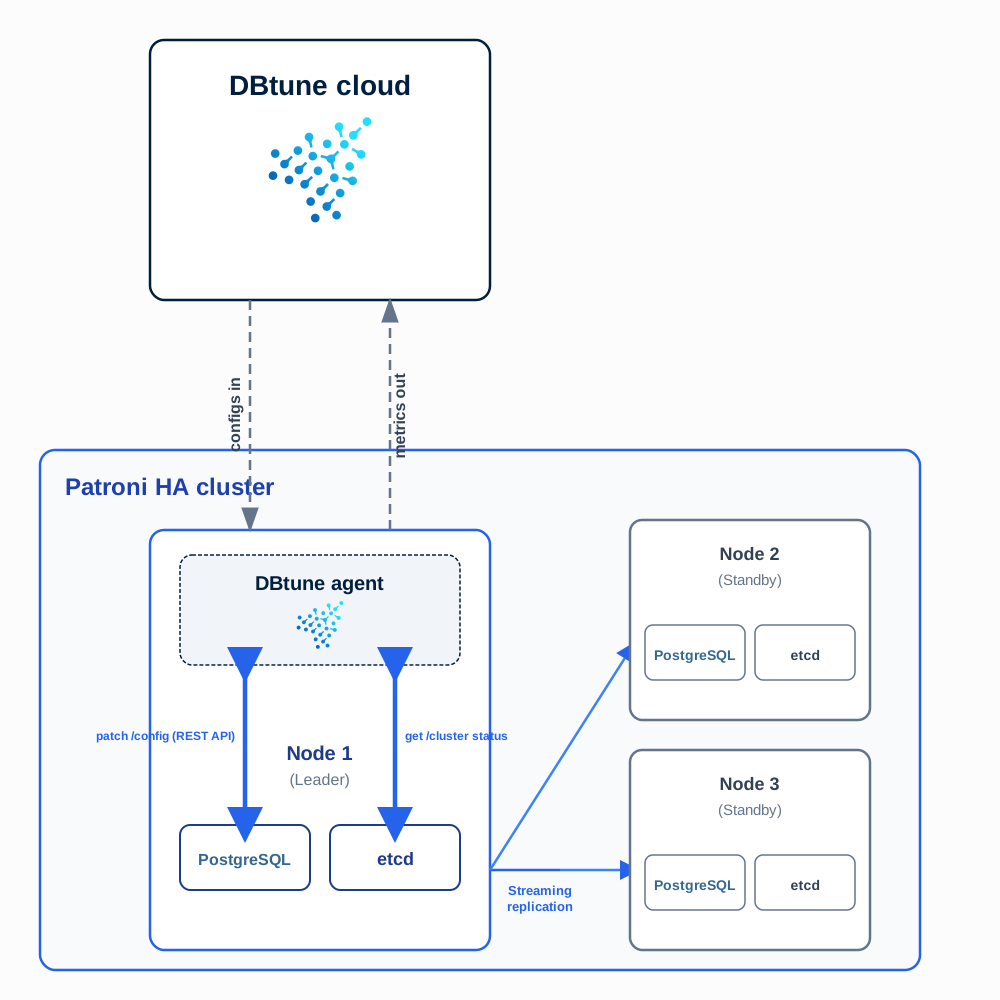
How DBtune detects and adapts to HA environments
Optimizing a standalone database instance is one task; however, optimizing a dynamic, Patroni-managed cluster requires a specialized approach. The DBtune agent is engineered with native HA awareness, specifically designed to tune the cluster based on the Leader (read/write) workload.
DBtune maintains cluster stability through several Patroni-specific mechanisms:
-
Node identification: Automatically discovers Patroni-specific nodes by querying the relevant API node endpoints.
-
Topology awareness: Performs real-time state checks to identify the active leader and verify cluster health before any tuning operations begin.
-
Tailored optimization strategies: Ensures configuration changes are context-aware, applying optimizations only when the environment is stable.
-
Conflict prevention: Automatically skips parameters managed directly by Patroni—such as
wal_level,hot_standby,primary_conninfo, and others—to prevent orchestration conflicts.
To ensure maximum accuracy, DBtune employs a built-in check to verify that configuration changes are only initiated when the agent is running on the active leader node.
Why does this matter? Standby replicas do not process the same write-heavy or complex transaction workloads as the leader. Tuning based on replica metrics would lead to skewed data and potentially harmful optimizations that don’t reflect the needs of your production traffic.
Supported Patroni distributions
DBtune supports the community upstream distribution of Patroni. The integration has been rigorously validated on Patroni versions 4.1.0 and 4.0.x.
Furthermore, by leveraging the stability of the Patroni REST API, DBtune maintains full backward compatibility with legacy production versions, including the 2.x and 3.x series. This ensures that organizations can modernize their performance tuning immediately, without the need for high-risk orchestration upgrades or infrastructure overhauls.
Under the hood: Failover awareness
When a cluster fails over, DBtune follows a strict four-step protocol to ensure stability:
- Immediate halt: The DBtune agent continuously polls the Patroni REST API to verify cluster topology. The moment a change is detected, e.g., the leader becomes unavailable or the leader lock is released, DBtune triggers an immediate halt of the active tuning session. This prevents the agent from attempting to apply settings to a node that is currently being demoted or in an unhealthy state.
- Recovery period: Once a failover begins, the DBtune agent waits for the new leader to be promoted and reach a "healthy" status. This includes a 30-second stabilization period to ensure the new leader is not flapping and is fully ready to accept traffic.
- Baseline reversion: Following stabilization, a 5-minute failover grace period begins. This wait ensures the Patroni API and DCS are ready to reliably persist changes and allows PostgreSQL shared buffers to reach a continuous state of operation. DBtune then safely applies the baseline configuration across the entire cluster. Since Patroni synchronizes configurations via the DCS to all nodes, this ensures that even the former leader (now a standby) is reset to a known-good state.
- Automatic role transition: The agent on the old leader recognizes its new role as a standby replica. While it continues to monitor health, the agent will reject any new tuning sessions. Tuning is exclusively permitted on the active leader to maintain consistency across the streaming replication pipeline.
Additionally, to maintain human-in-the-loop safety, DBtune does not automatically resume tuning after a failover. A failover often indicates underlying infrastructure changes—such as shifted workloads or hardware differences between nodes. Therefore, a user must manually initiate a new session to ensure DBtune recalibrates its optimization strategy against the updated topology. To learn more about DBtune’s human-in-the-loop capabilities you can refer to this blog post.
Safety mechanisms and guardrails
Safety is paramount when altering performance parameters in an HA cluster. DBtune implements rigorous guardrails to ensure that AI-driven optimization never compromises the stability of your production environment.
Patroni configuration layer compatibility: Rather than manipulating local files, DBtune interfaces strictly with the Patroni REST API to ensure all changes are validated and synchronized across the cluster via the DCS. As a precaution, any existing local overrides in postgresql.auto.conf are first cleared so they cannot take precedence over the Patroni-managed configuration.
Failover session protection: To prioritize safety, DBtune does not automatically resume tuning during a failover. If a topology change is detected, the agent immediately aborts the active session. Once the cluster stabilizes, an administrator must manually initiate a new session to ensure decisions are made against a stable leader node.
Standby node guardrail: DBtune is engineered to apply changes only to the active Leader where writes are permitted. During the application phase, the Agent performs a final role check; if it detects the target node has transitioned to a standby role, it will immediately fail the application attempt to prevent data inconsistency.
Technical constraints & parameters
To maintain the delicate balance between high availability and performance, the DBtune-Patroni integration adheres to two core technical constraints:
-
Reload parameters only: To ensure zero downtime, this integration focuses exclusively on “online” parameters. DBtune identifies and optimizes settings that can be applied via a server configuration reload. By bypassing any parameters that require a restart, DBtune eliminates the risk of triggering unnecessary failover events or cluster re-elections.
-
"Single source of truth" (no node drift): To prevent configuration drift, DBtune ensures the Patroni DCS remains the authoritative configuration source. The agent proactively manages local overrides (such as those in
postgresql.auto.conf) to ensure that optimized settings are pushed through Patroni’s central configuration management.
Importantly, because Patroni enforces a unified configuration across the cluster via the DCS, it is not possible to tune read replicas with a different set of performance parameters than the leader. This ensures that in the event of a failover, the new leader is already running on the same optimized configuration as its predecessor.Note on local overrides! Do not use the
ALTER SYSTEMcommand to modify PostgreSQL parameters in a Patroni-managed cluster. PostgreSQL gives the highest precedence topostgresql.auto.conf(the file modified byALTER SYSTEM), which causes the database to ignore the cluster-wide settings managed in the Patroni DCS. This leads to configuration drift and potential instability during failover events.
Operational constraints & deployment requirements
To ensure the highest levels of reliability and data accuracy, the DBtune integration operates within the following technical boundaries.
-
Service unavailability for rollback: The DBtune agent operates solely on the Patroni leader node. A failover scenario, whether due to a crash, restart, or planned maintenance, causes the agent to stop because its host (the leader) is no longer available. Although Patroni automatically promotes a replica to the new leader, the DBtune agent does not automatically failover. Consequently, tuning must be manually resumed by starting the agent on the newly promoted leader node.
-
Configuration rollback constraint: If a node fails during active tuning and does not rejoin the cluster within the agent's failover grace period (5 minutes), since the agent won’t be online, it cannot execute SQL-level verification queries on that specific node to confirm baseline rollback. When the failed node eventually rejoins the cluster—even hours or days later—its last tuning iteration configuration will persist on the node rather than the baseline configuration. Manual intervention is required if the user wants to restore the node to the baseline configuration before starting a new tuning session.
-
Node-local agent deployment (DBtune architectural requirement)
To ensure accurate telemetry of hardware metrics—including CPU, RAM, and IOPS—the DBtune agent must be configured to monitor the leader database host directly. Connecting the agent via a proxy, connection pooler (like PgBouncer), or load balancer is strongly discouraged. Doing so causes the agent to baseline performance against the proxy’s hardware constraints rather than the database server's actual capacity. This miscalibration prevents the optimizer from fully utilizing your server’s resources, resulting in suboptimal tuning.
Continue your performance journey
- The business value of high availability: Learn how to eliminate the "infrastructure tax" and unlock hidden ROI in your Patroni clusters by reading our business impact blog.
- Patroni documentation: Ready to optimize your high-availability setup? Read our step-by-step Patroni integration guide to learn how to deploy the DBtune agent and start orchestrating performance across your self-hosted clusters today.
- CloudNativePG (CNPG) integration: Running on Kubernetes? Discover how to tune CloudNativePG without the guesswork using DBtune’s native K8s integration.
- Real-world success: Discover how Midwest Tape achieved a 10x performance boost on AWS RDS and how Papershift cut query times and CPU usage by 50% with zero manual intervention.
- Marketplace integration: DBtune is available on the AWS Marketplace and Microsoft Marketplace, offering seamless AI-powered performance tuning for your Microsoft Azure and Amazon RDS for PostgreSQL instances.
- EPAS support: Enterprise users can leverage automated tuning for EDB Postgres Advanced Server (EPAS), bringing agentic AI to the most demanding Oracle-compatible environments.
FAQ
Q: Can I see a DBtune demo in the context of a Patroni cluster?
A: For a step-by-step guide on how to configure the DBtune agent and launch your first tuning session in a Patroni environment, please watch our demonstration video here.
Q: Does DBtune cause downtime during the tuning process?
A: No. By default, DBtune operates in a server reload-only tuning mode. This allows the agent to optimize performance-critical parameters without requiring a database restart, ensuring zero service interruption for your high availability cluster.
Q: What happens if an automatic failover occurs while a tuning session is running?
A: Safety is DBtune’s priority. If the agent detects a failover or a change in cluster roles, it immediately triggers a safety halt. The session is terminated to prevent configuration drift, and the database is rolled back to its stable baseline configuration.
Q: Can I use DBtune to tune my standby node differently than my leader node?
A: No. In a Patroni environment, configuration is managed cluster-wide via the DCS. Since PostgreSQL gives precedence to the local postgresql.auto.conf file, any node-specific manual overrides can conflict with the cluster-wide settings managed by Patroni. To prevent configuration drift and ensure cluster stability, DBtune automatically resets these local parameters on the leader node so that the DCS remains the single source of truth across all nodes. Consequently, DBtune optimizes the cluster as a single logical unit, ensuring that both the leader node and all standby nodes maintain a consistent configuration.
Q. Is there a free trial available for self-hosted Patroni clusters?
A. Yes. You can try DBtune for free on up to three database instances. This allows you to observe how AI-driven optimization improves the performance of your specific Patroni workload before committing to a subscription. Try it out at app.dbtune.com.
Q. How does DBtune prevent configurations that might destabilize my cluster?
A. DBtune includes built-in safety guardrails that monitor resource utilization and performance metrics. If a proposed configuration causes performance degradation or approaches memory limits, the agent automatically rejects the change and reverts to a known stable state.