
Looking back at three months of PostgreSQL performance tuning: Agentic AI in action
Explore DBtune's Q1 2026 report on PostgreSQL performance tuning. Learn how an agentic AI database achieves database cost optimization and faster PostgreSQL query optimization.

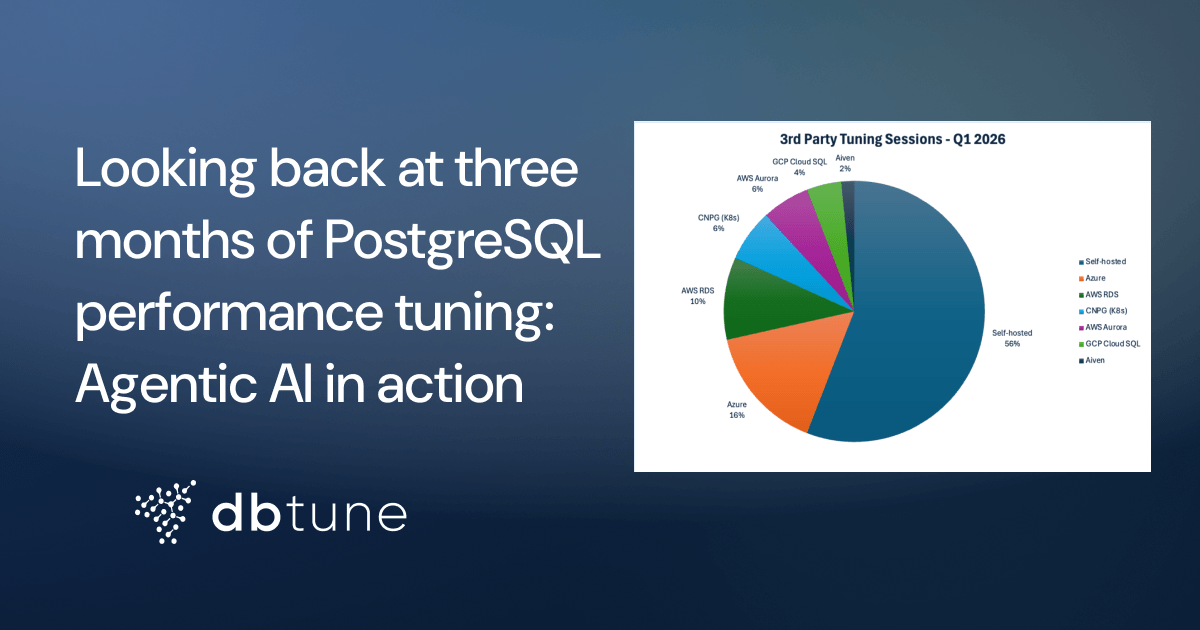
This blog takes a quick look at three months of agentic AI-enabled PostgreSQL tuning on DBtune’s online tuning platform in Q1 2026. Q1 is notable, as we introduced several new capabilities in that timeframe:
- Tuning of Cloud Native PostgreSQL on Kubernetes
- Support for Patroni-based high availability
- Human in the loop
- Workload Fingerprinting
Caveat: This analysis does not include customer-driven tuning sessions on the self-hosted version of DBtune, which is frequently used by enterprises with specific compliance requirements.
Findings
In Q1 2026, over 250 tuning sessions were executed in https://app.dbtune.com – that’s a multiple of what we experienced in previous timeframes. We attribute this to the very popular new features introduced in Q4 2025 and Q1 2026.
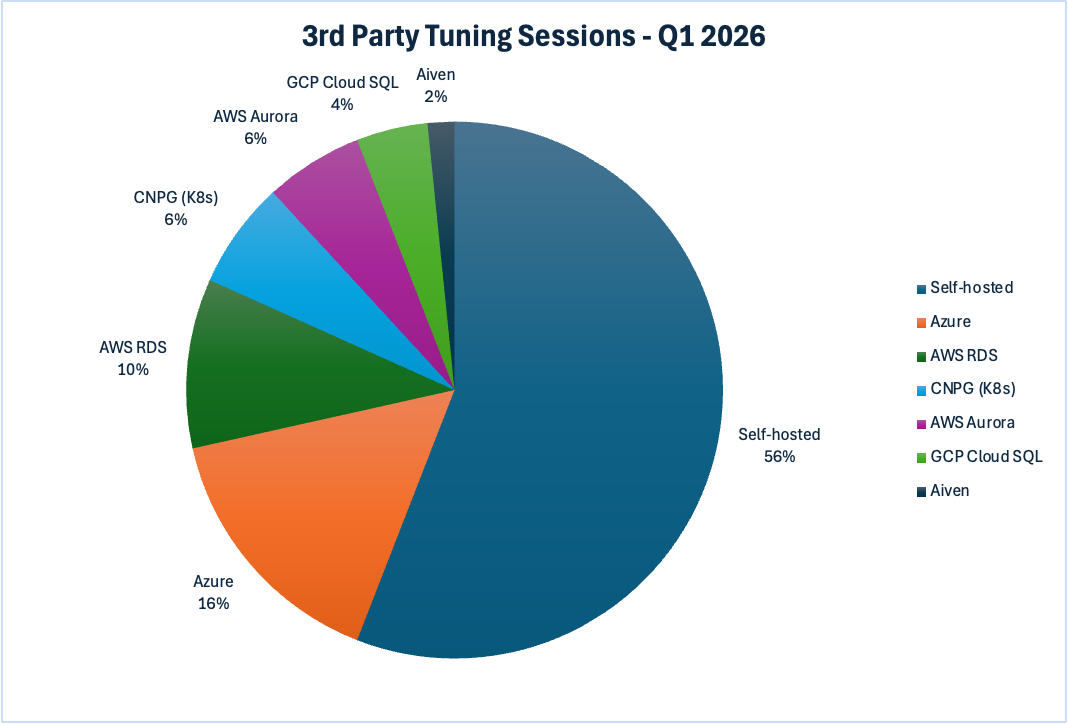
When we exclude any DBtune-operated tuning sessions that our team did for demos, sales, marketing, and QA, we see that while DBtune is very popular in self-hosted environments, 36% of the tuning sessions were for public cloud-managed PostgreSQL deployments on AWS RDS, AWS Aurora, Azure PostgreSQL, and GCP Cloud SQL.
Ready to see these results on your own data? Start your free trial or book a demo with a tuning expert to start optimizing your performance and costs today.
| Platform | % of tuning sessions |
|---|---|
| Self-hosted | 56% |
| Azure | 16% |
| AWS RDS | 10% |
| CNPG (K8s) | 6% |
| AWS Aurora | 6% |
| GCP Cloud SQL | 4% |
| Aiven | 2% |
Managed cloud performance
While cloud services are convenient, their performance out-of-the box is often suboptimal because they use "one-size-fits-all" defaults that are workload agnostic. Managed databases, just like self-hosted systems, benefit from precision tuning to handle unique concurrency and memory demands that generic configurations miss.
When we analyze the performance improvements measured in terms of Average Query Runtime (AQR) in milliseconds that users experienced, we see that DBtune has a significant value proposition for self-hosted implementations and for users of managed services — even though those services already offer pre-configured and partially optimized PostgreSQL deployments.
| Platform | Average AQR performance improvement |
|---|---|
| Self-hosted | 2.2 |
| Azure | 1.6 |
| AWS RDS | 1.7 |
| CNPG (K8s) | 1.5 |
| AWS Aurora | 2.7 |
We did not have enough data to provide a meaningful evaluation of the 3rd party performance improvement for Aiven for PostgreSQL or for Google Cloud SQL. We believe that the relatively low CNPG improvements in this data set are related to a higher level of expertise of those users and simplistic benchmarks.
We also looked at the PostgreSQL versions that users tuned to make sure that DBtune’s value proposition was not limited to any specific PostgreSQL versions. We observed a trend towards the use of PostgreSQL 18 and a pretty evenly distributed DBtune value distribution.
The surprisingly high percentage of PostgreSQL 18 is likely due to users trying out DBtune and using the most recent install kits — it is not likely to be a reflection of PostgreSQL version distribution in production installations.
| PostgreSQL version | Frequency of use | Average AQR performance improvement |
|---|---|---|
| 14 | 11.90% | 1.31 |
| 15 | 4.76% | 2.68 |
| 16 | 5.95% | 1.60 |
| 17 | 11.90% | 1.29 |
| 18 | 65.48% | 1.72 |
We also looked at how long tuning sessions take from start to finish.
| Platform | Average tuning session duration (min) |
|---|---|
| Self-hosted | 208 |
| Azure | 236 |
| AWS RDS | 180 |
| CNPG (K8s) | 142 |
| AWS Aurora | 185 |
Most sessions were close to the average and finished in three to four hours.
Analysis
The data outlined above shows that DBtune has a significant value proposition across all deployment platforms and all current PostgreSQL versions, and that DBtune can help reduce hosting costs, avoid overprovisioning, and improve customer satisfaction.
However, the data has to be taken with a grain of salt:
- The relatively high use of PostgreSQL 18 is likely due to the “Proof of Value (PoV)” effect, where one spins up a test version to ‘take DBtune for a spin’. Our experience with production deployments shows a preponderance of versions 14-17.
- While the improvement numbers shown above are impressive and are a strong indicator of what DBtune can do, they are below what production customers have reported. For example, Midwest Tape has reported a 10x improvement, and Papershift has reported over 2x performance improvement at 50% lower CPU usage. This discrepancy is likely due to the use of simplistic benchmarks (pgpench, HammerDB, Epinions, etc.) during a PoV. Those benchmarks have simplistic workload patterns that do not highlight complex performance bottlenecks that can be addressed with DBtune’s real-world capabilities. As we do not have access to the actual database designs or schemas, our analysis cannot differentiate between artificial workloads and production systems.
We attribute the fact that DBtune has seen a steep increase in adoption in 2026 to:
- A growing understanding that managing PostgreSQL at scale can only be done with intelligent automation, such as the agentic AI technology provided by DBtune.
- Enterprise-level features, such as Human in the Loop, Patroni integration, and Kubernetes CNPG support that were introduced in 2025 and early 2026, have made AI-based database tuning enterprise-ready.
Conclusion
Agentic AI-based database tuning is getting significant attention and has become a key tool to improve performance and manage cost. Tools, such as DBtune, allow more teams to have success with PostgreSQL, and instead of spending hours (or days) on tuning PostgreSQL, they can focus on innovation in the next project.
Start your free trial or book a demo to experience how DBtune transforms performance and cost savings of agentic AI today.
Frequently Asked Questions
Q: What is agentic AI database tuning?
A: Agentic AI for databases is an autonomous, goal-oriented technology that continuously perceives the database state, plans experiments, and executes optimizations. Unlike static scripts, it uses continuous learning to adapt to shifting workloads in real-time.
Q: Can you tune PostgreSQL performance on AWS RDS and Azure?
A: Yes. While managed cloud services like AWS RDS and Azure PostgreSQL offer default optimizations, agentic AI can further improve performance by tuning memory and concurrency settings that cloud providers leave at "one-size-fits-all" defaults.
Q: How does DBtune improve PostgreSQL query optimization?
A: DBtune uses "Workload Fingerprinting" to analyze specific query patterns and execution times. By aligning the system configuration to these unique fingerprints, it optimizes query performance at the infrastructure level without requiring manual SQL code changes.
Q: Is it safe to tune PostgreSQL in High Availability (HA) environments?
A: Yes, provided the tool is cluster-aware. DBtune safely optimizes HA environments like Patroni and CloudNativePG (CNPG) by using declarative manifest updates, ensuring peak performance without risking accidental failovers or production downtime.
Q: How does database performance tuning reduce cloud costs?
A: Tuning reduces Average Query Runtime (AQR) and CPU usage. By making the database more efficient, organizations can achieve significant infrastructure spend reduction, allowing them to downsize cloud instances and avoid unnecessary overprovisioning.
Q: Can I try DBtune for free?
A: Yes, you can access the DBtune engine for free, without any commitments, at DBtune.com. You can use it for up to three database servers that are self-hosted, on RDS, on Azure, or any other supported PostgreSQL flavor.
Q: Does DBtune have a ‘Human in the Loop’ mode, where I approve all changes?
A: Yes, that was introduced in early 2026 and is described here.
Q: Can I do a quick trial of DBtune without creating my own PostgreSQL benchmark?
A: Yes, app.dbtune.com gives you the option to try DBtune in a Docker container using a test database that DBtune provides. This gives you the full tuning experience without having to set up your own environment.
Q: Can I buy DBtune on one of the cloud marketplaces?
A: Yes, DBtune is available on the Azure and AWS marketplaces. These marketplaces can be used to acquire subscriptions for any PostgreSQL flavors, not only Azure and AWS.